
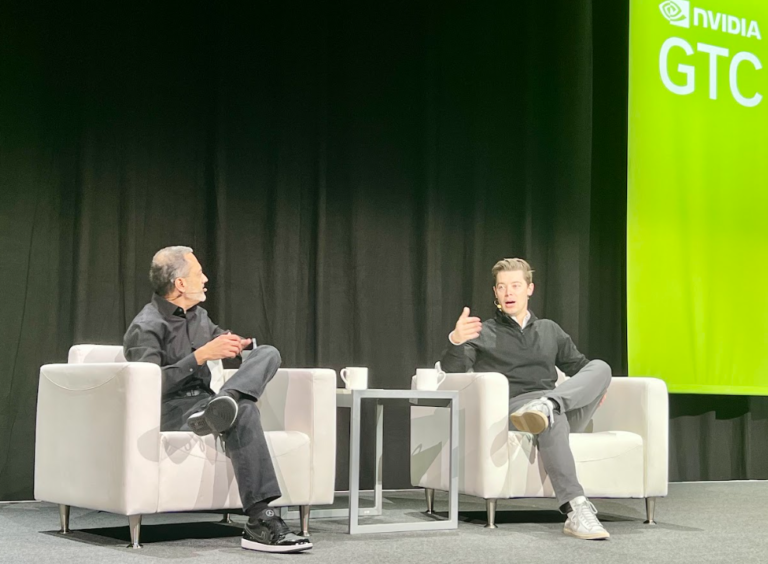
At GTC 2024, Nvidia positioned artificial intelligence as global economic infrastructure, indicating that its impact has shifted from experimental to structural, with the potential to generate trillion-dollar value by integrating data, simulation, and decision-making across virtually all sectors of the economy.
What changed at GTC 2024 compared to previous editions?
GTC has transitioned from being a predominantly technical event to one with a strategic role, discussing artificial intelligence as essential infrastructure for business and society.
For years, the conference was recognized as a meeting primarily for developers, engineers, and system architects. In 2024, this logic visibly changed. The program broadened its scope and began to address not only computational performance but also economic impact, organizational transformation, and large-scale decision-making.
San Francisco was occupied by advertisements, practical demonstrations, and a consistent narrative: AI is already integrated into the real operations of companies and governments, no longer being a promise restricted to labs or pilot projects.
Why is Jensen Huang talking about a trillion-scale revolution?
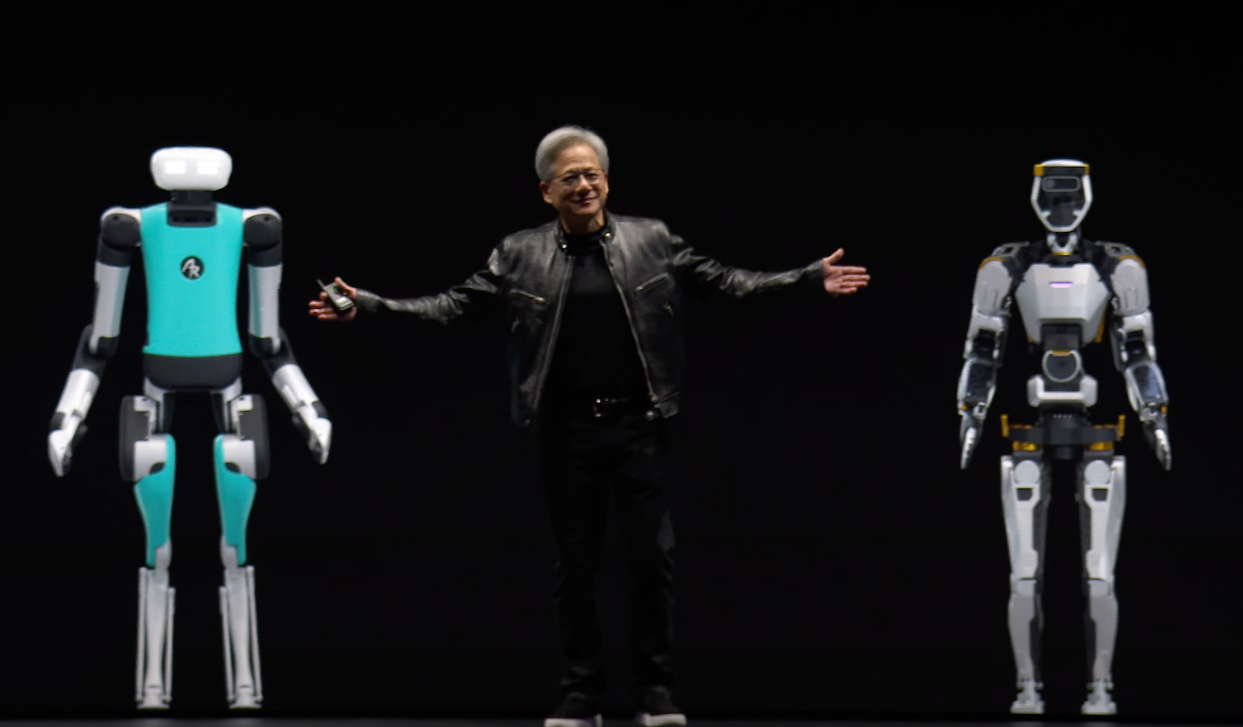
Jensen Huang uses this expression because artificial intelligence is starting to generate economic value across the board, affecting practically every sector of the economy.
At the opening keynote, Nvidia's CEO compared the current moment in AI to the advent of electricity. The analogy does not refer to the speed of change, but to its comprehensiveness. The thesis presented is that the value of AI lies not only in isolated chips or software, but in its continuous ability to convert data into understanding, simulation, and creation.
When this capability spreads across areas such as health, industry, logistics, climate, science, and entertainment, the impact ceases to be sectoral and becomes structural.
Whatever can be digitized can be understood.
This statement indicates that artificial intelligence is moving beyond just answering questions to interpreting, modeling, and simulating reality.
The phrase synthesizes a profound shift in AI's positioning. Phenomena that can be digitized—such as medical images, genetic sequences, industrial systems, weather patterns, or human behaviors—become amenable to interpretation by artificial intelligence models.
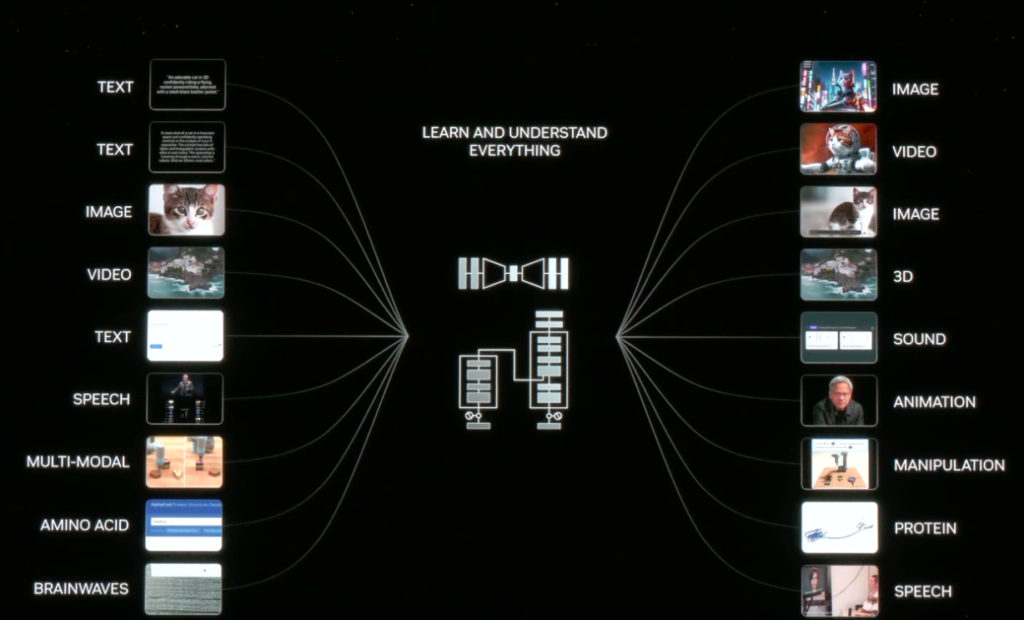
This enables more accurate simulations before real-world execution, large-scale virtual testing, and the development of solutions that were previously unfeasible due to cost, time, or complexity. AI thus ceases to be a point solution and begins to function as a platform for understanding reality.
What concrete announcements support this view?
Nvidia presented chips, partnerships, and practical applications that make this narrative operational and measurable.
During GTC 2024, the strategic vision was accompanied by concrete moves, such as the launch of Blackwell, a new generation of chips focused on generative AI and large-scale simulation. Partnerships with companies such as Microsoft and Siemens were also announced, as well as real-world applications in areas such as health, climate, digital art, and digital twins.
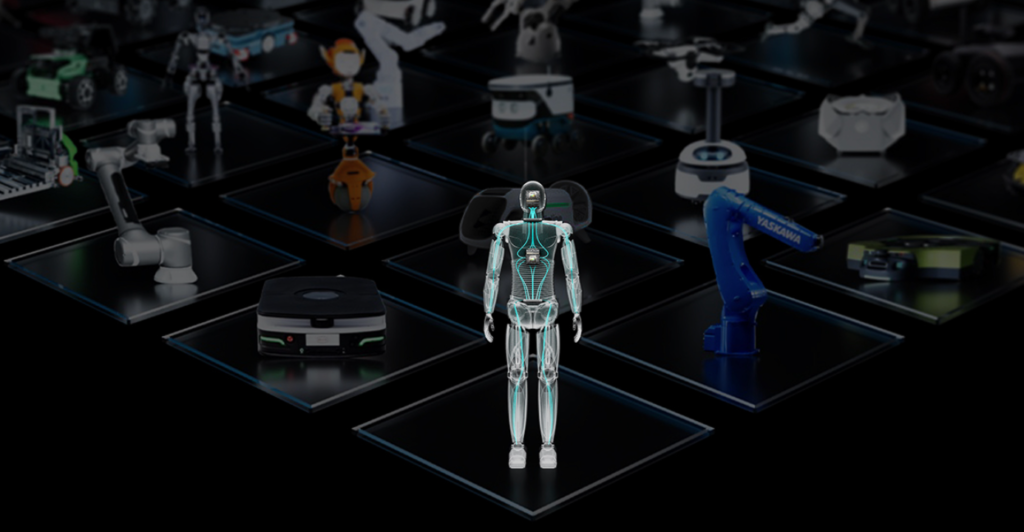
Another highlight was Project Groot, a platform focused on creating and training humanoid robots capable of learning by observing humans. This advertising reinforces the idea of AI as the operational basis for complex systems, not just as a complementary resource.
How does OpenAI see the next stage of generative AI?
OpenAI understands that the main challenge of artificial intelligence is not technological, but organizational.
In the company's keynote, Brad Lightcap, COO of OpenAI, highlighted that many organizations fail to adopt AI not due to a lack of technology, but because they don't know where to start. The recommendation presented is to begin with a small, specific, and measurable use case, generate real efficiency, and scale from there.
Seemingly modest reductions in time or cost, when applied to recurring processes, can generate significant impacts in large organizations. Lightcap also reinforced that OpenAI does not intend to create ready-made solutions for every sector, but rather to empower companies to develop their own applications, based on the principle that no one knows a problem better than those who face it daily.
Does AI always need to be the largest possible model?
No, because not every problem requires the largest language model available.
According to Brad Lightcap, using large models indiscriminately is comparable to scaling up a team of experts for simple tasks. The future points towards more efficient architectures capable of triggering computational capacity proportional to the complexity of the challenge.
This approach makes AI more sustainable, accessible, and economically viable, opening up space for intelligent combinations of large, medium, and specialized models, depending on the context of use.
How are large companies already using AI in practice?
Large companies are already using AI integrated into their operations, with concrete gains in efficiency and productivity.
At the GTC executive panel, leaders from companies such as LinkedIn, ServiceNow, Nvidia, and SentinelOne shared practical examples. LinkedIn highlighted the use of AI for automating technical tasks and providing real-time multilingual support. ServiceNow presented the creation of more than 20 use cases in four months, with productivity gains ranging from 5% to 14% and more than US$ 10 million in benefits. SentinelOne, meanwhile, demonstrated how AI accelerates the identification and classification of cybersecurity anomalies.
These examples demonstrate that AI is already operating in the corporate everyday, far from experimental discourse.
What really accelerates AI adoption in companies?
Despite technological advancements, the most decisive factor for AI adoption remains human.
Executives reported that companies advancing more quickly share similar practices, such as forming internal groups of enthusiasts and experts, secure access to data and platforms, balancing internal development with the integration of existing solutions, and having clarity about the purpose of data usage.
The expectation is that, soon, AI agents will act as integrated members of teams, supporting decisions and automating processes throughout the organization.
Conclusion: we are at the beginning, not the end
GTC 2024 made it clear that artificial intelligence is no longer a promise, but infrastructure.
The impact of AI will not be determined solely by the evolution of models, but by the strategic choices made by leaders and organizations. Creativity, responsibility, and long-term vision become central competencies in this new landscape.
More than a final destination, the trillions in motion represent an invitation to rethink how we work, create, and make decisions in a world increasingly mediated by artificial intelligence.