Published 05/23/2023 at 1:59 PM
Note: The term “Deaf” was capitalized due to the preference of a portion of the community to be represented in this manner.
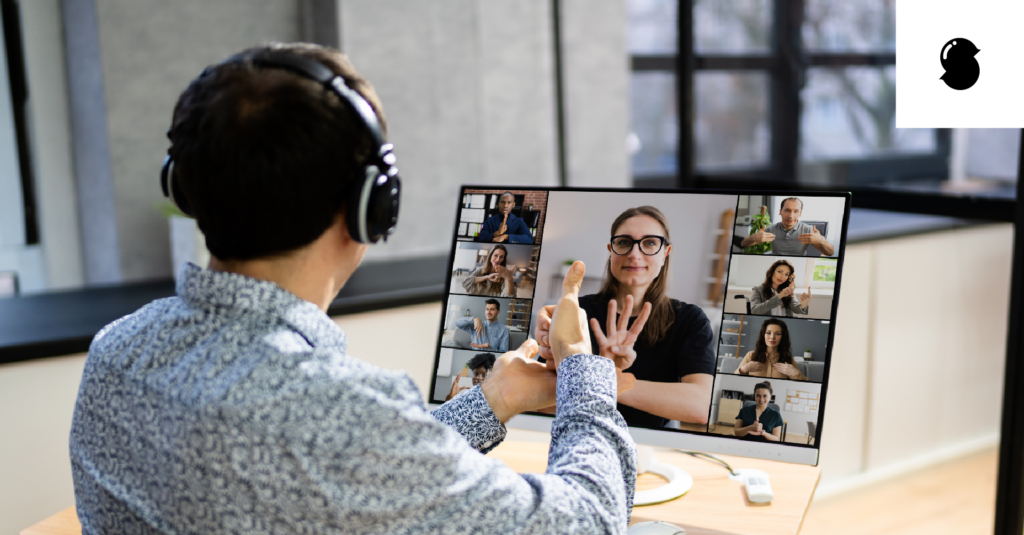
A Sabiá Agency received on Friday (19) the LIBRAS translator and interpreter, Simone Miyashiro, for its first Diversity Session of the year. The initiative is a way for the team to stay in touch with relevant issues that directly impact Brazilian society. The date was also chosen due to its proximity to World Day for Cultural Diversity for Dialogue and Development, which was celebrated on Sunday, May 21.
Simone has worked on various projects and events in the city of São Paulo and currently translates and interprets classes for Deaf people in academic settings.
The conversation revolved around the issues arising from different perspectives on deafness, the existence and role of the Deaf community in a predominantly hearing society, and the organization of this community around a language, LIBRAS.
For Miyashiro, starting from an approach focused on respect for diversity, empathy is important, but it is not enough:
“It is not enough to have empathy. We must study and begin to deepen our knowledge to normalize our coexistence with these people, outside and inside the workplace. Not only Deaf people, but also all those with some form of disability.”, recommends the expert.
The use of the term “deaf-mute” is inappropriate.
During the event, Miyashiro commented that there is a myth surrounding the issue of deafness involving the term “deaf-mute.” For a long time, this term was used to designate Deaf people because it was believed that there was a relationship between deafness and muteness. However, Deaf people are not incapable of producing sound, as their vocal tract, which is responsible for phonetic production, is perfectly functional. Because of this, the correct term would be just “Surdo” or “Surda”.
“Deaf people can learn to speak if they want to undergo speech therapy. Therefore, in principle, deafness does not come with muteness. For this reason, they identify as the Deaf community, a Deaf person, and this is not pejorative,”Explain.
Unlike mutism, which is not such a common occurrence, There are 10 million people identified as Deaf in Brazil, which is equivalent to 5% of our total population, according to data obtained by the Brazilian Institute of Geography and Statistics (IBGE) in its 2010 census. This category includes people with mild, moderate, severe, or profound hearing loss, which is the case when they no longer hear anything or practically anything.
The overview of deafness is still largely based on the medical model
![On the left, the painting by Oscar Pereira da Silva, entitled “A palavra aos surdo-mudos” [The word to the deaf-mutes], indicating a possible interpretation of the reason for the perpetuation of the term. On the right, an illustration of a cochlear implant, a surgery performed with the intention of neutralizing deafness.](https://agenciasabia.com.br/wp-content/uploads/2023/05/image1-390x227.jpg)
On the left, the painting by Oscar Pereira da Silva, entitled “A palavra aos surdo-mudos” (The word to the deaf-mutes), indicating a possible interpretation of the reason for the perpetuation of the term. On the right, an illustration of a cochlear implant, a surgery performed with the intention of neutralizing deafness. Source: Reproduction – Internet.
In his lecture, Miyashiro highlighted the two models in which disabilities can be seen, with a focus on deafness. Among them are the medical model, which starts from the viewpoint that it is a disability that can be alleviated or neutralized, and the social model, which views deafness as linguistic and cultural differences.
With the spread of the medical model as the accepted standard, several critical and highly detrimental points are established for communities such as the Deaf community. First, they begin to be viewed as a deviation from normality, that is, subject to normalization. This creates a view that these people depend on the help of others to integrate into society. LIBRAS, from this perspective, ends up being reduced to a deficient language that serves as support so that these people can communicate with hearing society.
The social model proposes another point of view, starting from the assumption that the Deaf community is made up of independent subjects, capable of generating and producing knowledge just like any other person in society. In this model, the focus falls on their categorization, since they come to be seen as a linguistic minority, which presents different—yet valid—ways of expressing and organizing themselves.
The “myth” of LIBRAS as a second language in Brazil
“Is LIBRAS the second official language of Brazil?” the speaker asked at one point. Amidst an atmosphere of uncertainty, some people claimed yes, while others said no.
It is often spread the idea that the second official language of Brazil is LIBRAS. The reason for this is the law No. 10,436/2002, which merely recognizes the Brazilian Sign Language as a legal and official form of communication in Brazilian territory.However, Miyashiro clarified that LIBRAS is not the second official language of Brazil.
“The LIBRAS law does not characterize it as an official language, but rather as a possible language of communication. In other words, its existence is recognized, and that is all. In countries like the Netherlands and Canada, which have established second languages, laws are written in both the first and second languages. In schools, both languages are taught. Here, this does not happen with LIBRAS.”, compare.
According to the expert, even if it does not serve to institutionalize LIBRAS as a second language, the law is a step forward and an important tool for the maintenance and survival of the Deaf community as a linguistic community, as it keeps their linguistic rights guaranteed.“The same thing does not happen with other linguistic minorities, as is the case with indigenous peoples.”, he explains.
LIBRAS is not “mime” nor is it universal
Regarding the Brazilian Sign Language more specifically, Miyashiro unveils some common-sense statements about the language that do not correspond to reality. First, she states, we cannot fall into the myth that Brazilian Sign Language is universal. Every place in the world has its own sign language community with its intersecting cultural differences., just like any spoken language, such as Portuguese, English, and Spanish.
From this, it is necessary to say that LIBRAS is not an artificial language. This means that no one thought up and designed the language; rather, it emerged spontaneously from the need of a linguistic community, just like the vast majority of natural languages. Furthermore, it possesses all the linguistic aspects of these languages, such as phonology, morphology, syntax, semantics, and so on. Moreover, language acquisition in deaf children occurs in the same way as in spoken languages when they are exposed to an environment where LIBRAS is widely used.
Finally, It is necessary to dispel the idea that LIBRAS is equivalent to gestures or mime.. Also, LIBRAS is not the sign language version of Portuguese. Contrary to what one might think, sign language and the Portuguese language are completely different and are not based on one another.
Here is a look at some of the linguistic aspects of sign languages that prove they are natural languages:
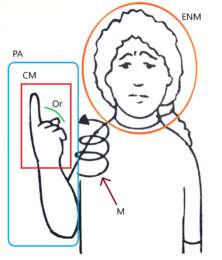
Each of the parameters indicated in the image as an example. Source: Researchgate
- Handshapehow your hand is configured; whether open, closed, with two fingers raised, etc.
- Movementwhat kind of movement is made with the hands;
- Palm orientationwhich direction is the palm of the hand facing;
- Place of articulation: where on the body the sign is performed;
- Non-manual expressions: any unprinted aspect from the hands or their movement. For example, facial expressions, posture, etc.
The Deaf community has its own cultural identity
Around this linguistic minority community, a cultural identity is also built. In São Paulo, for example, there is the São Paulo Deaf Association (ASSP), founded in 1954, with the aim of bringing the community together and creating a space for cultural exchanges.
“Nowadays, associations remain active by promoting events, parties (…) Often, associations offer courses and the possibility of volunteer work, which is a great opportunity to get to know people and this community.”
In the context of sports, Simone explains that deafness does not qualify people for the Paralympics, largely due to the specific requirements this population would need at the games. Furthermore, in some cases Deaf people do not consider themselves disabled, especially those who were born deaf and/or acquired sign language during the appropriate period of linguistic development. Therefore, the Deaf community tends to organize its own sporting events. There are even the Deaflympics, organized by the International Committee of Sports for the Deaf.
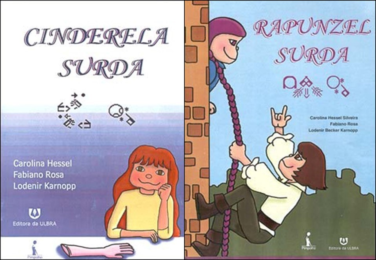
Books “Deaf Cinderella” and “Deaf Rapunzel”, an attempt to bring literature closer to the cultural identity of the Deaf community. Source: Reproduction - Internet
The Deaf community is also quite active in the literary field. Especially in capitals, such as São Paulo, there are quite a few poetry readings and slam events organized by Deaf artists who present original poetry and works constructed in Sign Language. Furthermore, there is an attempt to recreate classic fairy tales by bringing them closer to Deaf culture.
For those interested in learning LIBRAS or even integrating activities from the Deaf community, Miyashiro recommends consulting institutions such as National Federation of Education and Integration of the Deaf (FENEIS).