
Published on 05/17/2023 at 09:00 AM
On this May 17, 2023, World Telecommunication and Information Society Day, the theme chosen by the International Telecommunication Union is “Empowering the least developed countries through information and communication technologies.”.
According to the International Telecommunication Union (ITU), in 2022, 66% of the world's population participated online, while only 36% of the population in the least developed countries went online. These numbers demonstrate that the digital inclusion gap is still a complex and very present problem today.
It is for this reason that the Fifth Conference on the Least Developed Countries (LDC5) established quite ambitious goals for a new United Nations program aimed at delivering sustainable development for all nations by 2030. However, just a few years away from that goal, much remains to be done.
What is World Telecommunication and Information Society Day?
Celebrated every May 17th, it has been taking place since 1969, starting from the First International Telegraph Convention and on the anniversary of the ITU, which was founded in 1865. It is a day dedicated to the understanding of themes involving the exchange of information and communication in a general scope, taking into consideration the technologies that transform these processes over time.
What is the importance of this day for global digital inclusion?
Year after year, as communication and human relationships are transformed by the internet and digital media, the issue of global connectivity becomes increasingly complex. It is no longer enough just to create ways for people to be connected to the internet, but rather to think of ways to make this experience safe, healthy, productive, and accessible.
However, this challenge becomes even greater when we are talking about countries that lack the financial and technological support to keep up with the digital transformation. In this global race for digitalization, less developed countries end up falling behind. World Telecommunication and Information Society Day serves as a reminder and a catalyst to make this transformation possible for all nations.
What are the least developed countries?
Least developed countries are considered as such because they exhibit low socioeconomic index indicators, according to criteria evaluated by the United Nations. The organization's list includes 46 countries with this status: 33 on the African continent, 9 in Asia, 3 in the Pacific, and 1 in Central America.
The complete list can be checked Here.
Facts and figures: the focus on the least developed countries
The International Telecommunication Union presented a report gathering data on the state of connectivity in least developed countries, bringing to light relevant information on the digital divide, with the intent of using it as a tool to adopt measures to eliminate the situation.
Let's check out some relevant insights below that the material brings us:
Internet usage
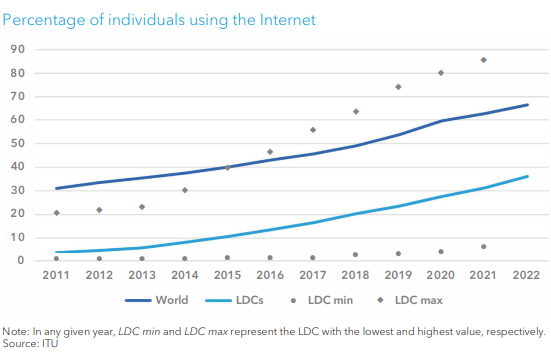
Chart showing the disparity in internet usage between people in the least developed countries and the rest of the world.
With regard to internet use, there is a graph that shows global internet use in dark blue, based on the total world population, while light blue represents the portion of that total that belongs to less developed countries.
Only 36% of the population in least developed countries had been online in the past three months, counting from the date of the survey. There are 407 million people online, compared to 702 million who still do not have access due to the internet.
Mobile internet coverage
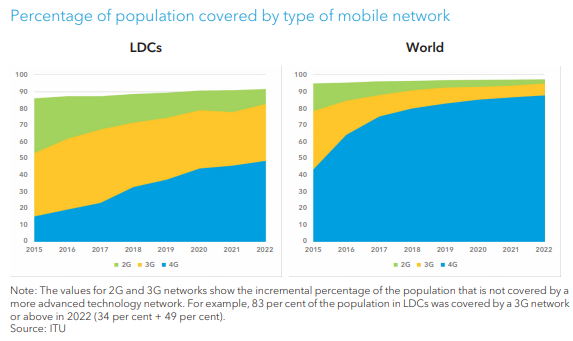
Two charts showing the reach of mobile network coverage in percentage, on the left in the least developed countries, and on the right in the rest of the world.
According to the data indicated in the report, mobile internet is the main — and often the only — way to access the internet in least developed countries. As can be inferred from the graph, a large portion of this access is via 3G. Even so, the report points to the information that Only 83% of the territory corresponding to the population of the least developed countries has mobile internet coverage, compared to 95% from the rest of the world's population.
In other words, although 3G or higher-speed connections are the primary means of accessing the internet in these countries, 17% of them do not have such coverage.
Accessibility
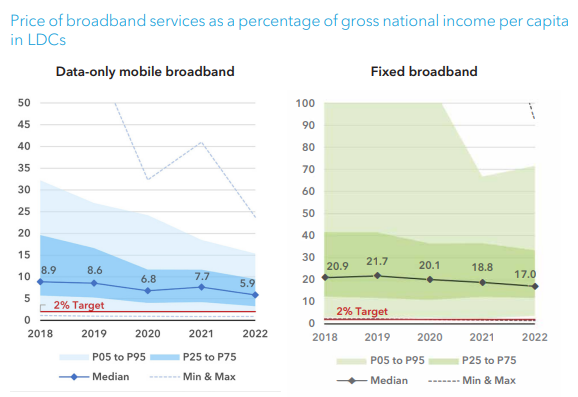
Two graphs representing the proportion that the cost of a broadband internet plan takes up of a person's salary in the least developed countries. On the left, mobile data internet; on the right, fixed internet.
The two graphs above represent the percentage of gross per capita income that the price of broadband services represents in least developed countries. The blue graph on the left refers to data-only networks, while the green one on the right represents fixed broadband.
The report points out that The price of a mobile broadband subscription with a monthly data allowance of 2 GB is equivalent to nearly 6% of the average monthly income in less developed countries, which is about four times the global average cost of 1.5%. As the graph shows, the United Nations’ goal is for the cost to be less than 2%, as represented by the red line.
More information
The report also provides other important data, such as a comparison between the annual growth rates in internet use in least developed countries and the rest of the world, breakdowns by gender and age, and percentages between urban and rural areas.
To access the full report, simply download it from the ITU publications hub, in this link.